
#MyAIApprentice
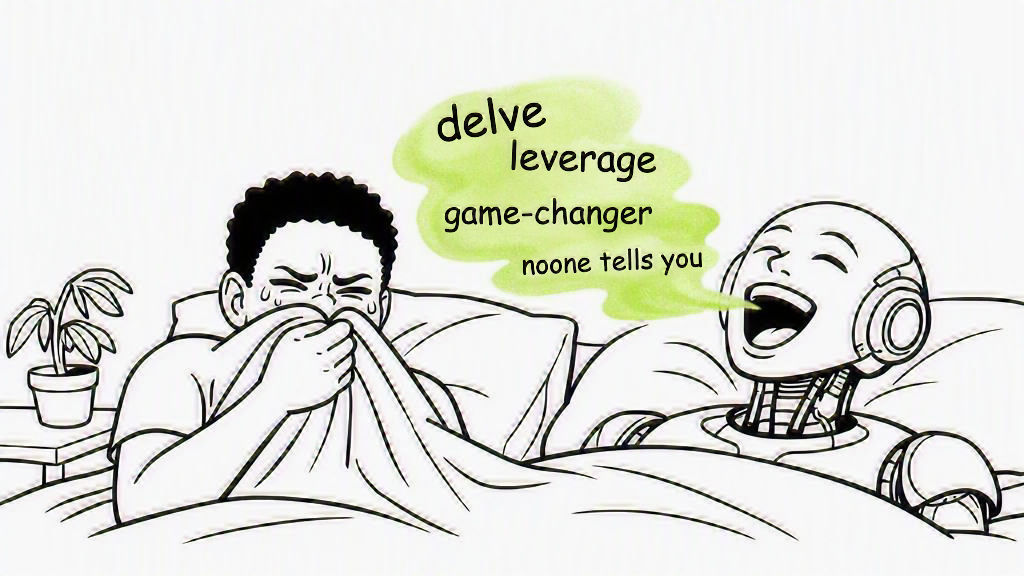
Who Loves the Smell of AI in the Morning?
TL;DR – The short version:
AI-generated writing has a smell, and it survives the tricks people use to hide it. You can delete the em dashes and retire the clever “it’s not X, it’s Y” and it still reeks, because AI writing tells are structural: the point stated twice, a post that interviews itself with “Why? Because…”, every sentence marching on its own line, lists that are suspiciously even, and above all writing that is advice-shaped but experience-free. The deepest tell is that the writer has never actually done the thing they are describing. The fix is one move: put a true, specific, slightly embarrassing detail back in. Swap one “I would” for one “I did”.
There is a moment in my morning routine when I catch up on the news, the thought pieces, the innovations in my industry. It used to be a time for reflection. A time to hold my own work up against what everyone else is doing and see where I stand. Now it is being stunk up by the smell of AI’s morning breath.
You know the stink I am talking about.
You are scrolling. A post slides up the feed. That one-line hook. Then a line break. A single dramatic sentence, alone, for effect.
The grammar is spotless. The em dashes have been carefully removed, because someone whispered that em dashes were a tell. The clever “it’s not a job, it’s a calling” has been retired too.
And yet. Something is off. It still smells like AI.
A short theory of smell
Your nose is faster than your brain. You walk into a room and you know, before you can say why, that the “fresh linen” you are smelling has never been near actual linen.
It is a chemical committee’s best guess at linen, sprayed evenly across every surface until the whole room is uniformly, plastically pleasant, and very slightly nauseating.
That is AI writing. It is the air freshener of language; Perfectly even, faintly sweet, and scented with “insight”. And once your nose is trained, you cannot un-smell it.
The top notes: AI writing tells that survive the perfume swap
People think the smell lives in the punctuation. Remove the em dash, they say, and you are safe. You are not.
The fragrance goes deeper than the bottle it came in. Here are the surface notes, the ones some people have already learned to spray over:
- The rule of three, always three. Never two, never four. And its evil twin, the negative triad: “not this, not that, not the other thing.” Three tidy clauses, marching in step. Humans are messier than that.
- The hedging adjective that does no work. “A quiet confidence.” “A simple truth.” “A humble reminder.” Delete the adjective and the sentence loses nothing, which is how you know it was scent, not substance.
- One word, rubbed threadbare. The writer finds a metaphor they like and wears it to a shine. Everything becomes a journey, a landscape, a game, a bet.
- The vocabulary. You know the words that make your top lip close your nostrils: game-changer, delve, unlock, leverage, elevate, empower, harness, foster, robust, seamless, streamline, navigate, landscape, realm, tapestry, testament, underscore, pivotal, spearhead, cutting-edge, transformative, resonate, unpack, “dive in”, “in today’s fast-paced world”, “at the end of the day”, “moving the needle”, “let that sink in”, and the one that makes you gag at the stench, “In conclusion.”
The base notes: where the real AI smell lives
Spray over all of that and the post still turns your stomach a little. The base notes go deeper than any word list:
- It states its own point twice. “If I had two weeks, here is exactly what I would do.” Then, eight lines later: “Now, if I had two weeks, this is exactly what I would do.” A human says the setup once and moves on. AI re-announces the thesis because it is stitching sections together, and it reaches for the word “exactly” to sound precise while promising nothing.
- It interviews itself. The one-word “Why?” on its own line, answered by “Because…”. Real people do not stop mid-thought to ask themselves a question and then answer it for you. That little call-and-response is a machine clearing its throat.
- Every sentence gets its own line. Not for meaning. For drama. The whole thing marches, one lonely sentence at a time, because that is the cadence the model was trained to imitate. Real writing bunches up and then sprawls. It breathes unevenly.
- The lists are too tidy. Five clauses, all the same shape and length. Four “Maybe it’s…” in a row. Real observation is lopsided. One item is always longer, or stranger, or slightly out of pattern. When every item matches, it was generated as a set.
- The decorative bluntness. “Nobody cares about that.” “They are literally paying for attention.” This is AI doing an impression of a plain-talking human. The bluntness is a costume.
- And the one underneath all the others: it has never done the thing. Read closely and there is not a single real detail. No business it actually found. No audit it actually sent. No reply, good or bad. No name, no number, no scar. It is all conditional. “If I had.” “I would.” “Maybe it’s.” AI writes in the hypothetical because it has no memory of Tuesday. That is the deepest note in the whole bottle, and once you smell it you cannot stop.
Smell test: Let me show you an example
Here is a post I see some version of every week. The niche changes. The smell does not.
The fastest way to land your first AI automation client in 2026 is probably not what you think.
If I had two weeks to get my first client, here is exactly what I would do.
Your first job is not to sell AI.
Your first job is to find businesses already losing money.
I would open the Facebook Ads Library.Why?
Because businesses running ads are already spending money.
They have a budget.
They have a problem.Then I would look for the gaps. They are getting leads but no follow-up.
They have no chatbot.
Their booking is manual.
Their sales team is wasting hours.
Their website visitors have nobody to talk to.These businesses are literally paying for attention. Nobody cares about the tech.
So I would record a personalized audit. I would show them the money. Do this every day. Find 20 businesses. Send 20 audits. Build proof.
The goal is not to sell AI. The goal is to show them the money walking out the door.
That’s how I would get my first AI automation client in 2026.
I love the advice given in the post. Clean grammar. No em dashes. But it reeks: Restated premise, the “Why? Because” self-interview, three “not this, it’s that” flips, a suspiciously even list of five, a “literally”, a “Nobody cares”, and under all of it, a person who has plainly never once opened the Facebook Ads Library and sent a real audit to a real business.
Now watch what one human hour does to it, I rewrote the above for this poster into the following.
Getting your first client as an AI automation specialist is less about pitching and more about proof. Here is the approach I would use if I were starting over.
First, be honest about whether you are ready. If you have not built a single working automation, chatbot or agent that does something real, spend the next fortnight building rather than hunting. Clients can smell someone who has read about the work but never done it.
Once you can actually solve a problem, the finding is easy. Open the Facebook Ads Library and look at businesses already paying to get customers. A company running ads has told you two useful things: it has a budget, and it has a problem worth money.
Then look for the gap between the ad and what happens after someone clicks. It is usually obvious once you follow the path yourself. The ad promises a fast response and the enquiry sits until the next morning. This happened to me when i was looking for pest control services. By the time some vendors answer a different one had delivered. You are looking for money leaking out of a machine that is already paying to fill the top of it.
If you really want to stand out: Skip the “Hi, I am an AI automation expert, do you need my services” message. Do the work first, before anyone has agreed to anything. Record a two-minute walkthrough of their customer journey and point at the leak: “I followed the path a customer takes on your site, and here are two places you are probably losing them, and roughly what that is worth every month.”
Then show the smallest fix that closes the biggest leak. Sometimes it is a chatbot. Sometimes it is automatic follow-up in the first five minutes after a lead comes in. Sometimes it is a booking link that kills six back-and-forth emails. Keep it to one thing they can say yes to.
Do that for twenty businesses in a fortnight. Most will ignore you. A handful will reply. One or two will book a call, because you did the thinking before you asked for anything, and that is rare.
Same advice. Same length, near enough. The difference is that a person is now standing behind it. The sentences vary. The list is uneven. Nobody interviews themselves. And there is a hole shaped exactly like a true story, waiting for the one thing a machine could never supply: a Tuesday I actually lived.
The point
None of this is a crime. AI is a wonderful tool. I use it every single day. I used it to write this post, and I used it to help me notice half of the AI writing tells I have mentioned, which is either deeply ironic or exactly the point.
If you are going to write with AI, learn to deodorise properly. The fix is smaller than you think, and it is always the same move: put one true thing back in. A real story. A real number. A real place. An opinion your compliance officer would ask you to soften. Swap one “I would” for one “I did”, and name the slightly embarrassing specific: the client who ghosted you, the awkward Loom, the four thousand rand you charged for your first job and undercharged badly. One lived detail breaks the spell instantly, because it is the one thing a machine cannot fake.
Right now, too few people are doing the work, and most of my feed smells like a strawberry scented toilet spray called “Thought Leadership”, and it’s giving me a headache.
I give AI-generated LinkedIn wisdom a nauseatingly synthetic 2 stars. It would be one, but it did save me some typing.
Since publishing this I have been scoring other people’s documents against the same twenty markers, and it turns out the list travels. If you want yours scored, I do thirty free minutes on something you have actually sent, live, with every marker quoted from your own page.
Sound Like You Again, the free read and the two-day fix.
Frequently asked questions
Why does my writing still sound like AI even after I remove the em dashes?
Because the strongest tells are structural, not punctuation. Removing em dashes and the “it’s not X, it’s Y” flip only clears the surface. What remains is the deeper pattern: restating your point twice, asking and answering your own questions (“Why? Because…”), putting every sentence on its own line, writing suspiciously even lists, and, most of all, writing advice you have never actually carried out. Those survive any find-and-replace.
What are the biggest tells that content was written by AI?
The rule of three used relentlessly, hedging adjectives that add nothing (“a quiet confidence”), one metaphor worn threadbare, a starter pack of buzzwords (delve, leverage, unlock, robust, seamless, “In conclusion”), a post that interviews itself, uniform one-sentence-per-line rhythm, and lists where every item is the same length and shape. The deepest AI writing tell is content that is entirely hypothetical, with no real names, numbers, dates or lived detail.
How do I make AI-written content sound human?
Add one true, specific, slightly embarrassing detail that only you could know: a real client, a real number, a real place, a real mistake. Swap one “I would” for one “I did”. Then break the rhythm so your paragraphs vary in length, make at least one list item uneven, and cut any sentence that asks itself a question. A single lived detail does more than a hundred edits, because it is the one thing a model cannot invent.
What words give away AI writing?
Common ones include delve, unlock, leverage, elevate, empower, harness, foster, robust, seamless, streamline, navigate, landscape, realm, tapestry, testament, underscore, pivotal, spearhead, game-changer, cutting-edge, transformative, resonate and unpack, plus phrases like “dive in”, “in today’s fast-paced world”, “moving the needle” and “In conclusion”. None are banned on their own. The AI writing tell is the density: several of them, evenly spread, with no real detail between them.
Is it wrong to use AI to write?
No. AI is a useful writing tool and most good writers now use it. The problem is publishing the machine’s default output, which is smooth, even and empty. Use it to draft, argue with, and edit faster, then put yourself back in: your real stories, your real opinions, the specifics only you have lived. The goal is not to hide that you used AI. It is to make sure a human is still the one doing the thinking.
This is part of the series My AI Apprentice, documenting the rebuild of my firm, AI-first, in public. Read the whole series · Start at part one.