
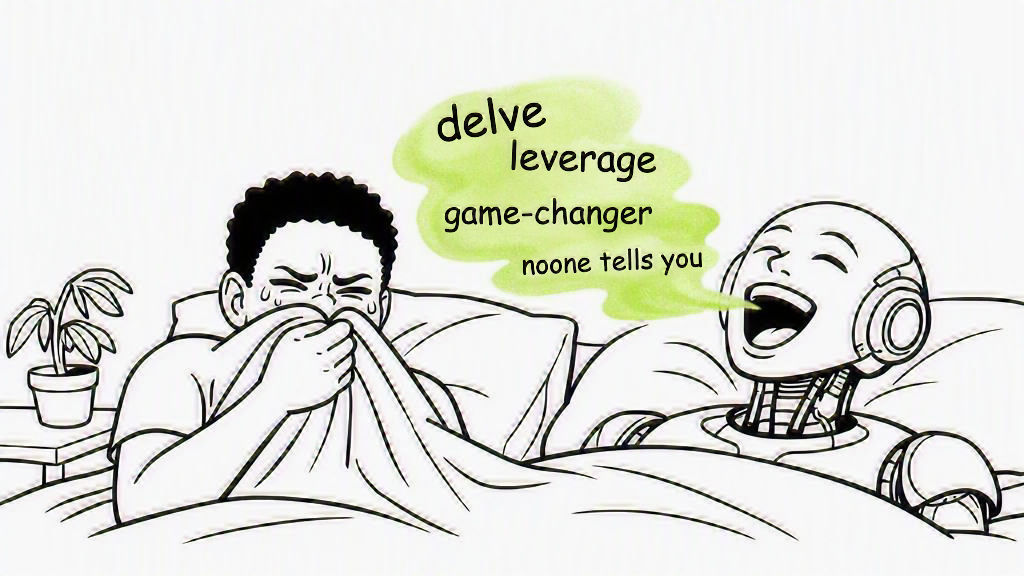
A two-day fix
Sound Like You Again
Your ideas are still yours. Your sentences should be too.
What I keep receiving
I can tell, and so can they
In July I nearly sent a client a credentials pack full of em dashes I had never typed in my life. I caught it on the last read. My AI assistant had written it, I had approved it, and it read like nobody in the building had thought about the client for a single minute.
Now the same thing arrives in my inbox every week from other people. A proposal, a deck, a board paper, a report. Good people, real expertise, work that took somebody eleven years to be able to do.
Four paragraphs in I stop reading it as an argument and start reading it as evidence that nobody thought very hard about the argument.
The reader rarely says “this is AI”. They discount the whole document at one rate and go looking for something else to compare you on. Usually price.
Em dashes are the least of it. Everybody’s learned to delete those. What survives every humaniser tool on the market is that the machine writes in the hypothetical, because it has never had a bad Tuesday. Twelve pages of advice from someone who has done the work, written as though they never had.
How I score it
Twenty markers, three tiers
I keep a list. It came out of four months of editing my own writing after that credentials pack, one rule at a time, until the guide ran past forty rules. Twenty of them turned out to matter to everybody.
Seven surface markers. Vocabulary, punctuation, formatting. Cosmetic, and most people have already learned to spray over them.
Seven heart markers. Sentence mechanics. The self-interview. The premise announced twice because the sections were stitched. The list where every item is the same shape and length, when real lists are lopsided.
Six base markers. These convict, and they all point at one absence. Real writing carries names, numbers, dates, a position somebody could argue with, and at least one thing that went wrong. Machine-default prose reproduces the shape of all five and the substance of none.
Density convicts, never a single word. You get a Machine Score out of 100 and a band, with every instance quoted and located in your own document, so you can argue with me about it.
| 0 to 15 | Reads as you. A trained reader would let it pass |
| 16 to 35 | Assisted and edited. Holds up. One or two markers to retire |
| 36 to 60 | Assisted and unedited. Caught inside a paragraph. Most business writing sits here |
| 61 to 100 | Machine default. The document is arguing on the machine’s behalf |
Start here
The consultation
Send me something you have actually sent to someone. Thirty minutes, cameras on, come exactly as you are.
I score it live in front of you and show you the three markers doing the damage, quoted from your own document. You leave with the score and the three markers whether or not you ever buy anything.
There’s no pitch in the thirty minutes. If the fix is obvious I’ll tell you what it is and you can go and do it yourself. Some people do. That’s a good outcome.
If you want it fixed properly
Two days. R3,000.
Day one, you get two documents.
The Tell Report: all twenty markers scored on your document, every instance quoted and located.
The Voice Profile: how you actually write, built from three things you wrote before you ever used AI. Your register, your rhythm, your idiom, and the three moves you make that nobody else makes. Every rule in it is quoted from your own writing, so none of it is my taste imposed on you.
Day two, you get two more.
Your document rewritten in that voice, scored again so you can see the movement.
A prompt block you paste into ChatGPT or Copilot or Claude once, and never think about again. I test it on a real task of yours before I hand it over, and I send you the test with its score.
The Voice Profile is the part that lasts. The rewrite is proof that it works.
The invoice goes out with the work, payable in 48 hours. Read the rewrite first. If it doesn’t sound like you, tell me and I cancel the invoice.
I carry that risk because by then I’ve read three samples of your writing and I know what’s in there.
Fit
Worth your time if
- You send documents that decide things. Proposals, bids, board papers, client letters
- Your expertise is the product, and writing is how people meet it
- Somebody has hinted, or you have suspected, that your work reads as generated
- You use AI to write, and the output has been drifting away from you for a while now, in a way you can feel and cannot name
And not worth it if:
- You want a score that beats a detector. Detectors measure statistical predictability and they are wrong often enough to ruin somebody. I won’t help you play that game, and I’ll say so on the call
- The work is an academic submission where AI use is against the rules. Different problem, different person
- You have nothing you want to say yet. That’s a real finding, it comes up more often than you’d think, and it needs coaching rather than editing
Who is doing it
Why me
I’m Thandwefika Tshabalala. I run projects for a living, I’ve been rebuilding my own firm around AI agents in public since 2026, and I write essays that people mostly read for the stories.
I built this list because I needed it. My own assistant kept handing me drafts that were correct and meant nothing, and every time I fixed one I wrote down the rule.
I published the whole method, free, before I ever charged anyone for it. Read it here. If you can get yourself under fifteen using the essay alone, tell me and I’ll publish that too.
Questions
Before you book
How do I make AI writing sound like me?
Give the model a written record of how you actually write, built from your own pre-AI writing, then put one lived, checkable specific into every important paragraph yourself. Instructions alone underperform. Instructions with quoted examples from your own work perform far better. The specific is the part no model can supply for you.
Do AI humanizer tools work?
They work on the seven surface markers: vocabulary, punctuation, formatting. They cannot add a real number, a real name or a real thing that went wrong, and that absence is what a trained reader notices first. A humanised draft usually moves from the machine-default band into the assisted-and-unedited band and stops there.
Are AI detectors accurate?
Detectors score how statistically predictable a text is, which is a different question from who wrote it. They produce false positives on writing that is provably human often enough that no decision worth making should rest on one. This service does not use them and does not optimise against them.
What is the most reliable sign that a document was written by AI?
Advice-shaped writing with no lived experience in it. Everything sits in the conditional, and the whole piece runs without a single name, number, date or scar. The writer has done the work and the prose reads as though they never had.
How long does it take to fix?
Two working days once your samples are in. That covers one document plus the profile and prompt block that fix the next ones. The Voice Profile is the slow part, because it is built out of your own writing line by line.
What does it cost?
R3,000 for the two-day engagement. The consultation before it is free and has no pitch in it.
Book thirty minutes
Bring one document you have actually sent to someone. Cameras on, and please come exactly as you are. Best in a room by yourself with headphones, because we’ll be reading your own writing out loud and that is easier without an audience.
Marketed under Thandwefika Tshabalala. Invoiced by DBiLL (Pty) Ltd.
Bring me the date and the room
Thirty minutes is enough to tell me the date, the room, and what you need people to walk out believing.